Journal of Puppet Science
Original Research
published: 24 February 2026
A Phylogenetic Hypothesis of Muppet Evolution
Acknowledgements
The author would like to thank Mr. Briar Patch for providing their muppet expertise and Hoodie Merg for their taxonomic knowledge and muppet enthusiasm. It was through bullshitting with them that many errors were rectified and connections made that may have otherwise been missed. This great work could not have been accomplished without their significant contributions.
The author is also grateful to use her bachelors degree in ecology for some damn thing.
Introduction
For thousands of years humans have utilized puppets to aid in storytelling. At some point, four or five thousand years ago, ancient people imbued figures of bone, clay, leather, or wood with life through performance and we’ve never looked back. The purpose of using puppets can be celebratory, religious, political, and/or comedic.
From Punch and Judy, to Howdy Doody. to Lamb Chop, there have been many famous puppets. But perhaps there are no puppets that have made as much of a cultural impact as The Muppets. They have made such a lasting impression on our very definition of puppet, that many non-muppet puppets take on their many forms and functions.
It is with this cultural legacy in mind that we endeavor to understand the evolutionary relationship The Muppets have to their puppet ancestors. Like other biological beings, they have evolved over time, with the genesis of each variation being mostly a mystery that can only be inferred by extant examples and archeologic evidence. Additionally, we have sought to give each muppet and puppet species a scientific name that is fitting to their mechanism and overall vibe. Being the first effort to define puppet taxonomy, we hope future puppet scientists will carry on and further these works.
Methodology
Definitions:
First, we must begin by defining what a puppet is. It has been surprisingly difficult to do so. An articulated doll or a stuffed animal has many of the same characteristics as a puppet, but they are not puppets. Much like other forms of life, such as species, or even certain visual media, such as pornography, ya know it when ya see it. But to ensure our study has some legitimacy, we will endeavor to define the qualities that make a figure a puppet with some amount of scientific rigor.
A puppet is any figure (not necessarily humanoid) that is (a) a physical object given the (b) illusion of life through (c) performance by (d) a puppeteer(s) using (e) a mechanism(s) to control movement. All aspects must be present to be considered a puppet.We define a “physical object” as any object that exists in space and time, that can be manipulated by a puppeteer. This quality is defined in order to separate puppet performance from animated performance.
We define the “illusion of life” as any figure that is moved and performed in such a way that they are understood to be separate from the puppeteer(s). The puppeteer is not pretending to be the puppet or any character the puppet portrays, nor do they expect the audience to view them as the puppet. They are merely a conduit from which life flows through and enters the figure. The puppet is understood by the audience to be a living creature with it’s own life force separate from that of the puppeteer’s.
Therefore, figures that are portrayed by an individual with the expectation that the audience understands that the individual’s life force and that of the figure’s are one in the same do not qualify as puppets. For example, although a fursuit physically resembles some puppets (full-body suits with an individual inside, sometimes containing mechanisms for movement of eyes, ears, mouths, etc., who is brought to life through a performance), the audience does not separate the life force of the fursuit from the life force of the individual inside the suit. Thus, a fursuit would be considered a costume and not a puppet. Additionally, one would hardly identify the individual inside the fursuit as a puppeteer.
We define “performance” as an artistic portrayal by the puppeteer that is created with the intention that the portrayal will be viewed by an audience. It can be live or recorded. For example, a stop-motion figure that is manipulated, photographed and edited together to create the illusion of life is a puppet.
A “puppeteer” is any individual who manipulates a puppet to create the illusion of life. The puppeteer may be visible or not, but must be present. Although automatons have many features that define a puppet, they lack a puppeteer, and thus were not included in our hypothesis. Animatronic figures can be either puppets or non-puppets. If they are actively manipulated by a puppeteer, they are puppets. However, if they are controlled via a computer program (e.g. “It’s a Small World”), they are not puppets.
We define “mechanisms to control movement” as any method to manipulate the puppet that transfers one form of motion into the illusion of another form of motion. A mechanism need not be complicated to be a “mechanism.” It may be as simple as using the hand to to open and close the mouth to create the illusion of speaking or using a stick to move the figure back and forth to create the illusion of walking. It could be complicated or remote, such as with the use of animatronics.
We define a Muppet as any puppet created by Jim Henson or the Jim Henson Creature Shop. Although not every puppet created by these entities is part of the ensemble of puppets known as ‘The Muppets’, we will refer to all puppets originating from these sources as Muppets to reduce terminology and confusion.
Methods for determining taxa:
The mechanism of movement (henceforth referred to as the/a mechanism(s)) was the only logical option to separate puppets into taxa. Being that Muppets do not have DNA, we could not use genetic testing, and thus were forced to use morphological characteristics. Archaeologic evidence was used to determine the timeline for when a mechanism first appeared. Because movement is only possible via the puppeteer, the puppeteer factor is represented through their relationship to the mechanism.
Mechanisms can be largely grouped into two categories, external and internal. Mechanisms can be delivered directly via the hand or body of the puppeteer, or indirectly via a tool. Tools can be simple (a popsicle stick) or complex (radio animatronics). A puppet can have multiple mechanisms.
We did not include the material from which the puppet is made. Puppets can be and have been made from wood, clay, stone, bone, leather, fabric, foam, paper, plastic and/or metal. When a material was first used for puppetry can not be separated through archeological evidence. Some materials, such as fabric and plastic, obviously came later in the evolutionary timeline, but wood, bone, clay, and stone existed simultaneously and therefore cannot be used to separate species. Additionally, we found that because every species of puppet has been made of all manor of material, often with mixed materials, it was not a factor that could easily separate one species from another.
Results
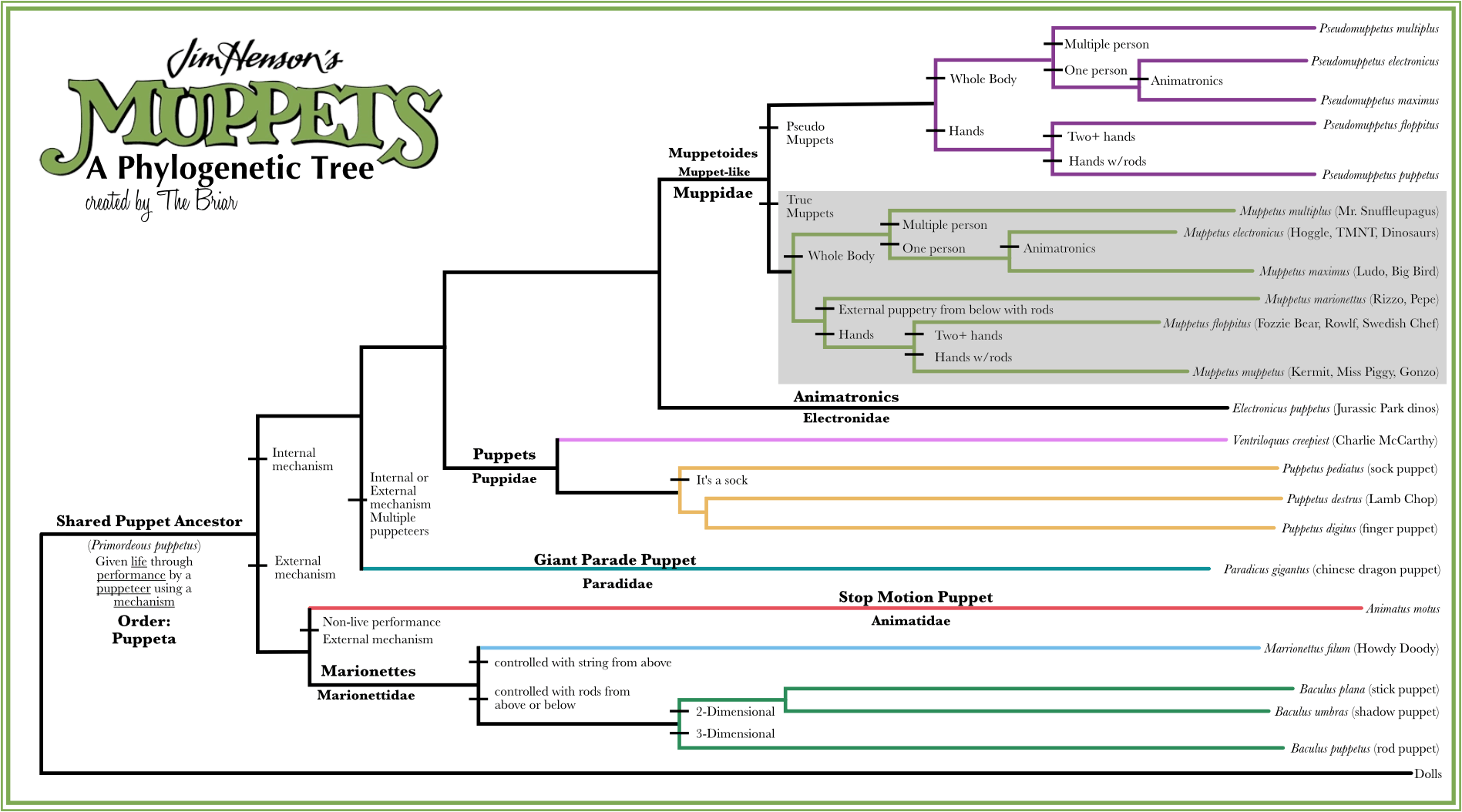
Figure 1. A phylogenetic hypothesis for the relationship between Muppets and all other puppet species. Presented here for the first time are taxonomic names for order, family, genus, and species of each puppet group and species. Muppet species are highlighted with a gray box since they are the focus of this study. Important features separating clades or species are noted. Click image to enlarge.
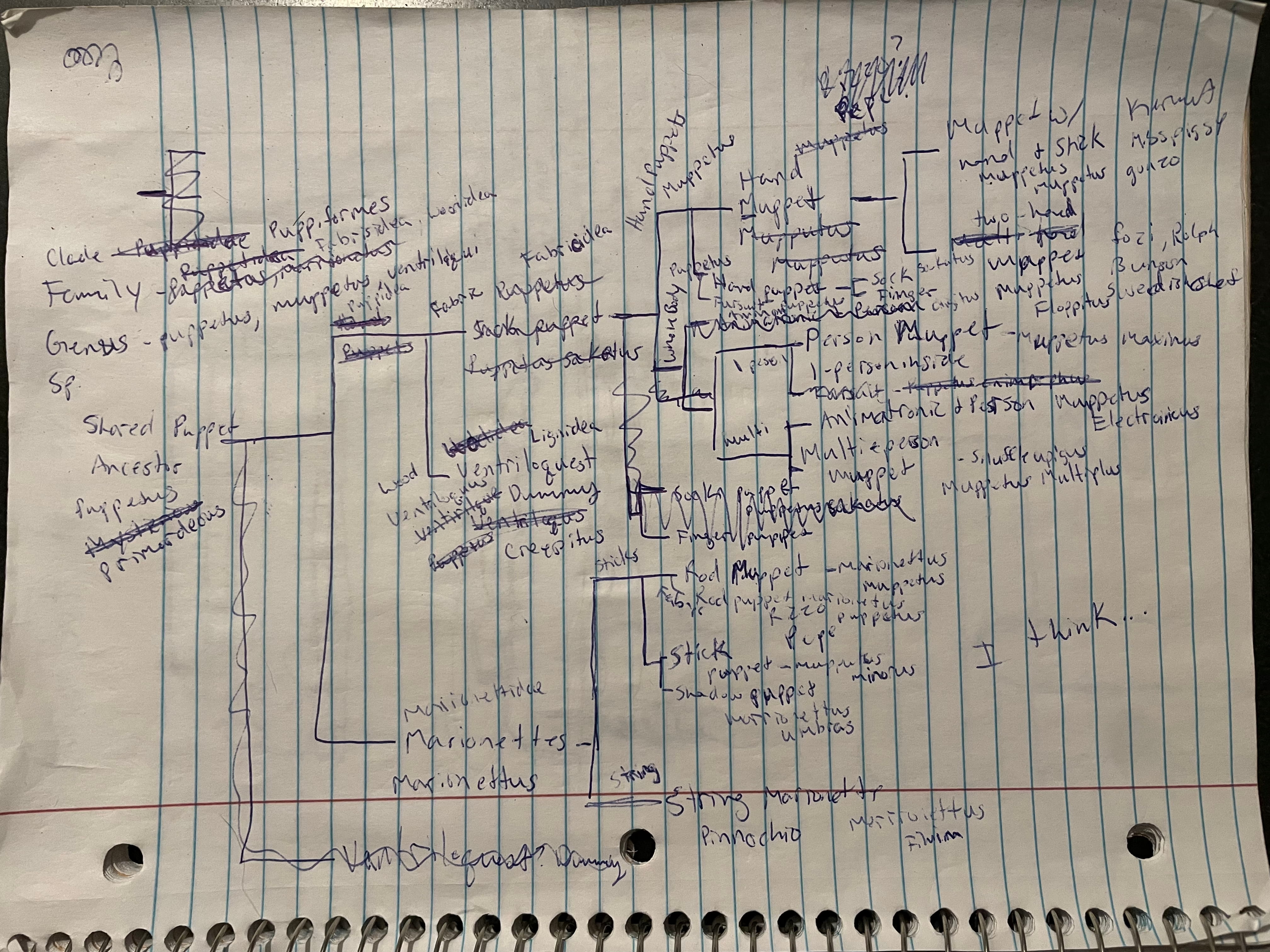
Figure 2. Working papers on how we theorized the categorization of Muppets.
Discussion
Although we don’t know the form of Primordeous puppetus, we know that it must have the qualities of a puppet that we have defined in our methodology (characteristics a-e). We have established Puppeta as the order that will contain all puppets from P. puppetus to the present day. The first known puppets were rod or marionette style puppets (Blumenthal, 2005). It is possible (indeed, likely) that P. puppetus was such a puppet.
It seems through the archeological evidence that external mechanisms evolved first. The earliest known puppets were written about it the 470-450 B.C.E by Herodotus. These puppets had external mechanisms that rose and lowered they’re massive phalli (Blumenthal, 2005). We have thus named this genus Baculus, meaning stick or rod, which is apt in more ways than one. We hypothesize that internal puppetry arose after external puppetry, which aligns with available archeological evidence. The genera Baculus and Marrionettus are placed in the Marionettidae family. While stop motion puppets (Animatus motus) are placed in their own family of Animatidae.
We hypothesize that all puppet species can be split into either internal or external mechanisms. Any puppet that exhibited both internal and external mechanisms we placed in the internal mechanism group. Firstly, because external mechanisms definitely evolved first and on their own. Secondly, any puppet that has internal puppetry presumably evolved from that first hand puppet. Therefore, any puppet that exhibits any internal puppetry must be within a clade that descends from that ancestor.
The next family in our tree is Paradidae which contains only one species, Paradicus gigantus, or the giant parade puppet. These types of puppets can contain internal or external mechanisms.
Puppidae is the next family. Puppidae contains your classic hand puppets. Any puppet manipulated with the hand inserted, partial or whole, we consider a hand puppet. This family has two genera Puppetus and Ventriloquus.
All puppets that take the form of Muppets, whether true Muppets or pseudo Muppets, were placed in the Muppidae family. We have subcategorized puppets that look and function like Muppets, but were not developed by Jim Henson or Jim Henson’s Creature Shop, into Muppetoides, or muppet-like puppets. Muppetoides could not have evolved if not for the evolution of true Muppets, and so they are placed on the tree with this timeline in mind.
Animatronic puppets (in the family Electronidae) are included, because their evolution is vital to the evolution of the Muppet. But we recognize that not all animatronic figures are puppets.
Our phylogenetic tree does not contain extinct species, for once a puppet species is born, it can never go extinct. Thank goodness.
Areas for further study:
Our hypothesis can be further perfected with a more accurate representation of time included in the phylogenetic tree. Although time is present in our tree, a phylogram could be developed to better represented the amount of change between each taxa.
We organized the evolution of puppets in a way that contained similar logical leaps in mechanism evolution. For example, a rod which moves parts of a puppet is similar to a stick that holds the puppet. Both are ridged objects used to move the puppet. We categorized this as a separate idea to string, which is a different material. This is of course an assumption. Perhaps the idea of string and the idea of a rod are the same, because they both manipulate only certain parts of a puppet. If this is so, then the organization of Baccilus would need to be rearranged.
We have placed only hand puppets in the Puppidae family, but perhaps Muppetus and Pseudomuppetus belong in this family as well. We considered them a separate family because they are often far more complex in mechanism than your standard hand puppet. This should be debated and assessed.
An argument could be made that all puppets in Psuedomuppetus should be in their own family. We included them in the Muppidae family because of our limitation of using only morphological characteristics to determine species. They look like muppets, and thus go in Muppidae.
Where animatronics fit into the external or internal dichotomy is another area for further study. The puppeteer is external to the figure of the puppet, however the mechanisms of the electronics are internal. It needs to be determined where the mechanism is considered to be originating. Does it come from the tool being used to manipulate the puppet (a hand, a rod, string) or does the origin of movement come from the puppeteer themselves? Additionally, animatronic puppets often have multiple performers, one inside the puppet controlling arm, body, and head movements, and one or more outside controlling the animatronics.
We struggled greatly on where to place stop motion puppets on this tree. Like other species that defy all attempts to categorize them into neat and tidy boxes, stop motion puppets are in a category all their own. Perhaps they don’t belong in this tree at all. In essence, they are really posable dolls, and are only brought to life outside of time through the power of film. They are externally manipulated, making them more like a marionette than anything in Puppidae or Muppidae. However, we will note that the way we placed them in the tree does not accurately represent their placement in evolutionary time. They evolved between hand puppets and animatronics. Although we possess endless enthusiasm, we simply lack the expertise in the creation of phylogenetic trees to figure out a better placement. We hope that another scientist smarter than us can figure it out in the future.
Another follow up question would be whether robots, controlled by an individual remotely and given life through performance would qualify as a puppet. Since puppets can be made of all manor of material, a robot’s mechanical and metal qualities do not disqualify it. The question is whether the individual manipulating the robot is considered a puppeteer and whether the audience views the life force of the robot as separate from that of the individual manipulating it. Another determination would need to be made whether robots and animatronics are one in the same when actively controlled by a puppeteer. But this was outside the scope of our study.
Conclusion
Figures with articulated limbs have been found from 470-450 B.C.E (Blumenthal, 2005). But a posable figure is not necessarily a puppet. We don’t know how such figures were used and if they had all the other attributes needed to be considered a puppet.
It is the illusion element that is the most defining characteristic of a puppet. The illusion of life. The illusion of movement. These are vital to the very nature of puppets. This illusion is also impossible to record in history before the invention of writing shit down. When the illusion first began will likely never be known.
We hope that these works will inspire others to further develop this hypothesis and to continue making breakthroughs in the realm of puppet science.
Citations
Blumenthal, E. (2005). Puppetry: A World History. Harry N. Abrams, Inc.